Successfully embedding hybrid work isn’t about new tools; it’s a complete organisational redesign that treats remote as the default operating system.
- Traditional management and communication models actively hinder hybrid performance and must be re-engineered.
- A strategic approach to office space and ergonomic compliance can simultaneously slash overheads and boost productivity.
Recommendation: Shift focus from managing presence to designing systems that support asynchronous work, intentional collaboration, and output-driven performance.
The transition to a permanent hybrid workforce is no longer a question of ‘if’ but ‘how’. For Chief Operating Officers across the UK, the challenge is a complex balancing act: accommodating employee demands for flexibility while controlling office costs and maintaining productivity. Many companies have responded with superficial fixes—subsidised lunches on office days, new messaging apps, or vague « flexible work » policies. These are temporary patches on a systemic issue. The common advice to simply « trust employees » and « communicate more » fails to address the deep operational shifts required.
The core problem is that most organisations are still running on a pre-2020 operating system designed for full-time, in-person work. Bolting on remote work as an exception creates friction, bottlenecks, and inequality. True adaptation requires a fundamental rethink. But what if the solution wasn’t about finding the perfect balance between office and home, but about redesigning the entire corporate machine to be location-agnostic? This involves re-engineering communication protocols, unbundling the role of middle management, and transforming the office from a daily requirement into a strategic tool for intentional collaboration.
This guide moves beyond the platitudes to offer a COO’s framework for this organisational redesign. We will dissect the critical components—from culture and communication to cost management and compliance—providing actionable strategies to build a resilient, high-performing hybrid organisation that is fit for the future of work in the UK.
Contents: A Framework for Organisational Redesign
- How to Maintain Team Culture When 70% of Staff Work from Home?
- The Communication Bottleneck That Delays Remote Project Delivery by 3 Weeks
- The £40,000 Solution to Reduce Office Overhead Through Smart Desk Sharing
- In What Order Should You Transition Your Sales Team to Fully Remote?
- Why Traditional Middle Management Fails in Remote-First UK Companies?
- How to Conduct an HSE-Compliant Desk Assessment for Remote UK Employees?
- Why Traditional Gantt Charts Fail Miserably for Fast-Paced Software Sprints?
- How Ergonomic Workspaces Slash Sick Leave and Boost Developer Productivity?
How to Maintain Team Culture When 70% of Staff Work from Home?
When teams are physically dispersed, the informal interactions that once built camaraderie—the coffee machine chat, the shared lunch—evaporate. Relying on forced virtual happy hours is a common but ineffective fix. The key is not to replicate office-based socialising but to design a new, intentional ‘Culture Cadence’ that fosters connection asynchronously. This means building rituals and systems that create a sense of shared identity and psychological safety, regardless of location. The goal is to make culture an active, engineered part of the work week, not a passive byproduct of physical proximity.
This systematic approach pays dividends. It turns out that productivity isn’t the issue; in fact, recent data shows 84% of employees in hybrid or remote setups report getting more work done. The real challenge is preventing feelings of isolation and disconnection. According to Culture Amp’s research in the UK, organisations that implement structured remote culture programs see a marked increase in engagement scores. The most effective strategies involve creating dedicated non-work channels for personal connection, documenting decision-making transparently to build trust, and establishing predictable virtual touchpoints like monthly coffee roulettes and quarterly team retrospectives.
A crucial component is the hybrid onboarding journey. New hires must be explicitly taught the company’s communication norms and cultural rituals. This shouldn’t be left to chance. Documenting these elements and integrating them into a formal onboarding process ensures that every employee, whether in-office or remote, understands how to connect, contribute, and belong. This intentional design moves culture from an abstract concept to a tangible set of practices.
The Communication Bottleneck That Delays Remote Project Delivery by 3 Weeks
The single biggest point of failure in a hybrid model is an over-reliance on synchronous communication. When every question requires an instant message or a meeting, remote workers are either left waiting for answers or forced to conform to the schedules of their in-office colleagues. This creates massive delays and frustration, leading to projects stalling for days, even weeks. The root cause is a system designed around immediate presence, where information is hoarded in individual minds rather than being documented and accessible to all. This is the bottleneck that cripples remote productivity.
The solution is to re-engineer your company’s operating system to be asynchronous-first. This means shifting the default from meetings and real-time chat to detailed documentation, thoughtful briefs, and well-structured project management tools. Synchronous time (meetings, calls) is then treated as a valuable, scarce resource reserved for specific purposes like urgent problem-solving, complex brainstorming, or relationship-building. This intentional split between deep, focused individual work and high-value collaborative sessions is the engine of a successful hybrid team.
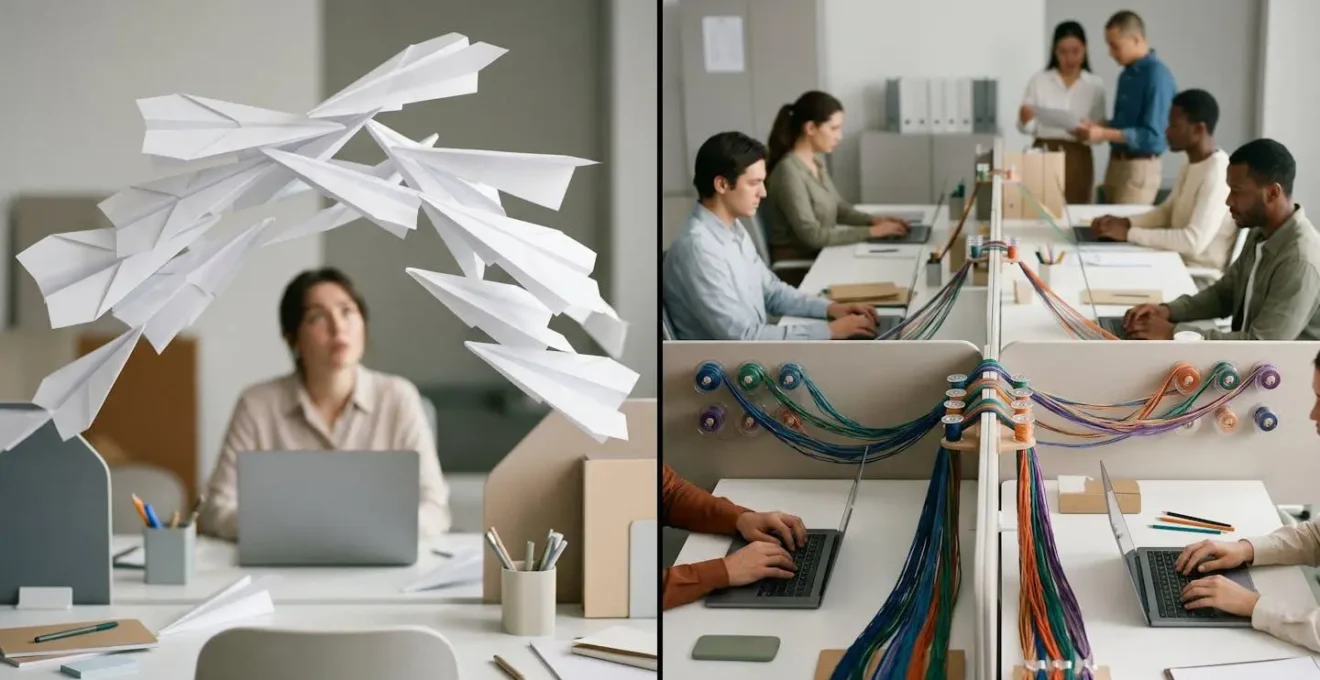
As the visual contrast above suggests, moving from chaotic, overlapping interruptions to clear, organised communication pathways is transformative. The data supports this shift from a synchronous-by-default model to a more balanced approach. An asynchronous environment allows for deep work and considered responses, while scheduled synchronous moments provide clarity and connection.
The following table breaks down the impact of different communication styles, highlighting why an asynchronous-first approach significantly boosts focused work time, which is critical for complex tasks and project delivery.
| Communication Type | Response Time | Productivity Impact | Best Use Case |
|---|---|---|---|
| Synchronous (Meetings) | Immediate | -18% due to context switching | Urgent decisions, brainstorming |
| Asynchronous (Documentation) | 2-4 hours | +27% improved focus time | Complex briefs, feedback rounds |
| Hybrid (Office Hours) | Same day | +15% balanced productivity | Q&A sessions, clarifications |
The £40,000 Solution to Reduce Office Overhead Through Smart Desk Sharing
For a COO, one of the most compelling arguments for a permanent hybrid model is the potential for significant cost savings on real estate. With fewer employees in the office on any given day, maintaining a large, fully-provisioned workspace becomes a major financial drain. However, a knee-jerk decision to simply downsize can backfire if it’s not part of a broader strategy for ‘intentional presence’. The office should no longer be the default place of work, but a strategic tool for specific, high-value activities like collaborative workshops, client meetings, and team-building events.
This shift in purpose allows for a more intelligent approach to real estate: smart desk sharing, or « hot-desking, » combined with flexible workspace solutions. By implementing a booking system, companies can precisely match office capacity to daily demand, eliminating wasted space. This isn’t just about reducing square footage; it’s about reallocating capital from fixed overheads to more strategic investments. The financial impact can be substantial, with UK businesses reporting a 25% average reduction in office space costs through such models.
The key is to treat the office as a service, not a fixed asset. This might involve moving to a smaller core office and supplementing it with on-demand access to meeting rooms or flexible workspaces in different locations. The success of this model is demonstrated by real-world examples in the UK.
Case Study: Hubble’s Part-Time Office Success Story
To prove the financial viability of a hybrid model, the workspace platform Hubble adopted it for their own team. According to their published results, Hubble saved an impressive £129,000 annually by moving to a part-time office model and sharing their space with another company. They successfully reduced their office footprint by 60% while maintaining team connectivity through strategically planned in-person days. This case study shows how a smart, flexible real estate strategy delivers a direct and significant return on investment.
In What Order Should You Transition Your Sales Team to Fully Remote?
Transitioning a sales team to a remote or hybrid model presents a unique set of challenges. Sales has traditionally been a field driven by in-person relationships and geographical territories. A poorly managed transition risks disrupting pipelines, demotivating top performers, and creating inequalities in lead distribution. A phased, systematic approach is essential, starting with the roles that are already most digitally native and moving outward. The goal is to build momentum and refine processes at each stage before tackling the more complex aspects of field sales.
The first step is to transition Inside Sales and Sales Development Representatives (SDRs). These roles are heavily reliant on digital tools (CRM, email, phone) and are therefore the easiest to move to a remote setup. Once this group is operating effectively, the focus can shift to Account Executives, which requires investment in high-quality virtual demo tools and ensuring seamless CRM integration for tracking activities. The final, most challenging phase involves transforming Field Sales. This requires a complete redesign of territory management, shifting from geographical patches to a strategic model based on industry verticals or account tiers, with in-person meetings reserved for high-value opportunities.

A critical part of this organisational redesign is actively combating proximity bias in lead allocation. In a hybrid environment, managers can unconsciously favour salespeople they see in the office. Implementing an automated, round-robin lead assignment system within the CRM is crucial to ensure fair distribution. Finally, compensation models must be reviewed and adjusted to be purely output-driven, rewarding results rather than physical presence or hours logged. This ensures that the entire system is aligned with performance, not location.
Why Traditional Middle Management Fails in Remote-First UK Companies?
In a remote-first environment, the traditional role of the middle manager—a supervisor who monitors presence, relays information top-down, and acts as a single point of control—becomes not just obsolete, but actively detrimental. When work is asynchronous and distributed, managers who rely on « managing by walking around » lose all visibility and control. They often respond by increasing meetings and demanding constant status updates, creating a culture of micromanagement that stifles autonomy and leads to burnout. It’s no surprise that 41% of UK managers report struggling to manage remote teams as effectively as co-located ones.
The failure lies in the role itself, which was designed for an industrial-era workplace. The solution isn’t to train managers to be « better » at remote surveillance; it’s to unbundle the management role. In a modern hybrid organisation, the monolithic role of « manager » should be deconstructed into several distinct, specialist functions that can be handled by different people. These functions include:
- The Coach: Focuses on individual career development, skill-building, and well-being.
- The Performance Manager: Sets clear goals, defines output-driven metrics, and conducts performance reviews.
- The Administrative Lead: Handles team logistics, resource allocation, and removes operational roadblocks.
- The Project Lead: Owns the delivery of specific projects, facilitating asynchronous workflows and communication.
This unbundling allows for greater specialisation and effectiveness. It replaces the managerial bottleneck with a distributed leadership model, empowering team members and freeing up senior leaders to focus on strategy. This is a core part of the organisational redesign, as demonstrated by leading UK firms.
Case Study: EY UK’s Hybrid Leadership Transformation
Consulting giant EY identified a major disconnect: while 90% of their UK employees desired flexibility, 75% of their leaders found managing hybrid teams exhausting. Recognising the traditional model was broken, they implemented a comprehensive leadership upskilling program. The focus shifted from supervision to empathy, digital fluency, and asynchronous communication. This transformation involved ‘unbundling’ the manager’s responsibilities, leading to improved team engagement and a significant reduction in manager burnout by distributing leadership functions more effectively across the team.
How to Conduct an HSE-Compliant Desk Assessment for Remote UK Employees?
For any UK business with a remote workforce, compliance with Health and Safety Executive (HSE) regulations is not optional. The employer’s duty of care extends beyond the office walls and into every employee’s home workspace. Specifically, the Health and Safety (Display Screen Equipment) Regulations 1992 require employers to conduct a suitable and sufficient analysis of workstations for all DSE users, including those at home. Failure to do so not only exposes employees to the risk of musculoskeletal disorders (MSDs) but also puts the company at significant financial and legal risk. The cost of non-compliance is steep, as HSE statistics show workplace injuries and ill health cost UK businesses £21.6 billion in 2022/23 alone.
A robust and documented process for remote DSE assessments is therefore a critical component of your company’s operational framework. This process should be systematic, scalable, and auditable. It typically begins with a digital self-assessment form that all remote employees are required to complete. This initial screen helps identify low-risk setups and flag individuals who may need further support. Based on these results, the company should have a clear policy for providing necessary equipment.
This often involves allocating a dedicated equipment stipend for employees to purchase HSE-compliant items like ergonomic chairs, monitor risers, and external keyboards. For employees who report persistent discomfort or have complex needs, a professional virtual ergonomic assessment should be scheduled. Every step of this process—from the initial self-assessment to the provision of equipment and follow-up reviews—must be meticulously documented to create a clear audit trail for insurance and compliance purposes. This isn’t just a box-ticking exercise; it’s a fundamental part of risk management in a modern hybrid organisation.
Your Action Plan: The HSE-Compliant Remote Assessment Framework
- Deploy mandatory digital DSE self-assessment: Ensure all remote workers complete this within their first week of remote work to establish a baseline.
- Allocate equipment stipend: Budget and provide a stipend of £500-£750 for employees to procure HSE-compliant chairs, monitor risers, and other ergonomic accessories.
- Schedule professional virtual assessments: For any employee reporting ongoing pain or discomfort, arrange a one-on-one virtual assessment with a qualified ergonomist.
- Document everything digitally: Maintain a central digital repository of all assessments, equipment purchases, and follow-up actions to ensure a complete audit trail for compliance.
- Review and update assessments: Implement a process to review assessments quarterly or whenever an employee’s remote working arrangement changes significantly.
Why Traditional Gantt Charts Fail Miserably for Fast-Paced Software Sprints?
In the new world of hybrid work, the tools we use for project management are just as important as our communication protocols. For teams engaged in fast-paced, iterative work like software development, traditional project management tools like Gantt charts are fundamentally flawed. A Gantt chart is a product of the waterfall methodology; it assumes a linear, predictable sequence of events and centralises control with a single project manager. This rigid structure is the antithesis of the agility required in a modern sprint.
When priorities shift mid-sprint—a common occurrence in software development—updating a complex Gantt chart is a cumbersome process that creates a bottleneck. It lacks real-time visibility for the entire team, making it poorly suited for asynchronous collaboration where developers need to see the current state of play at a glance, without waiting for a project manager’s update. The top-down nature of Gantt charts disempowers distributed teams, reinforcing a command-and-control structure that is ineffective in a remote-first culture.
The alternative lies in Agile tools built on frameworks like Kanban or Scrum. These tools are designed for the very realities that Gantt charts ignore: flexibility, transparency, and distributed ownership. A Kanban board, for example, provides a real-time, shared view of the entire workflow, accessible to every team member at any time. It empowers developers to pull tasks as they have capacity and makes bottlenecks instantly visible to everyone. This shift from a top-down, predictive tool to a bottom-up, adaptive system is essential for maintaining momentum in a fast-paced, hybrid environment.
This table clearly illustrates the operational advantages of modern agile tools over their traditional counterparts, especially in a distributed team context.
| Aspect | Traditional Gantt Chart | Agile Tools (Kanban/Scrum) |
|---|---|---|
| Transparency | Single point of control | Real-time visibility for all team members |
| Flexibility | Rigid waterfall structure | Adaptive to changing priorities |
| Remote Collaboration | Limited async capabilities | Built for distributed teams |
| Decision Making | Top-down bottleneck | Distributed ownership |
| Sprint Compatibility | Poor – assumes linear progress | Excellent – designed for iterations |
Key Takeaways
- Company culture in a hybrid setup must be actively engineered through a predictable ‘Culture Cadence’, not left to chance.
- An ‘asynchronous-first’ communication protocol is the single most critical factor for unblocking remote project delivery and boosting focused work.
- The role of the middle manager is obsolete; it must be ‘unbundled’ into specialised functions like coaching and performance management to be effective remotely.
How Ergonomic Workspaces Slash Sick Leave and Boost Developer Productivity?
Investing in employee well-being is not just a cultural initiative; it’s a strategic imperative with a clear financial return. For knowledge workers, and particularly for highly-skilled roles like software developers, their physical workspace directly impacts their output. A poor ergonomic setup—a laptop on a kitchen table, an unsupportive chair—leads to physical discomfort, which in turn leads to distraction, reduced focus, and ultimately, lower productivity. Over time, it can result in chronic musculoskeletal disorders (MSDs), a leading cause of sick leave in the UK.
Proactively investing in ergonomic workspaces is one of the highest-ROI decisions a COO can make in a hybrid model. This goes beyond the HSE compliance discussed earlier; it’s about optimising the primary tool of your most valuable assets. Providing high-quality, adjustable chairs, external monitors at the correct eye level, and ergonomic keyboards and mice directly translates into longer periods of uninterrupted, focused work. For a developer, this « deep work » state is where complex problems are solved and real value is created. Data from ergonomic program implementations shows a staggering 75% reduction in MSD incidents within the first 12 months.
The impact on the bottom line is multi-faceted. It includes a direct reduction in absenteeism and healthcare-related costs, but also a significant uplift in overall team performance. The evidence from large-scale studies is compelling, linking ergonomic investment to improvements across a wide range of business metrics.
Global Benchmark: The ROI of Ergonomics
A meta-analysis of 250 businesses conducted by the Washington State Department of Labor & Industries provides powerful evidence of the business case for ergonomics. Companies that prioritised ergonomic design saw, on average, a 25% increase in productivity, a 67% reduction in errors, a 58% reduction in absenteeism, and a 48% reduction in employee turnover. These figures demonstrate that investing in the physical well-being of a distributed workforce is not an expense, but a direct driver of operational excellence and profitability.
Ultimately, redesigning your organisation for a permanent hybrid workforce is a strategic, C-suite level project. It requires moving beyond reactive measures and adopting a proactive, design-thinking approach. By re-engineering the core operating systems of culture, communication, management, and compliance, you can build a resilient organisation that not only accommodates flexibility but thrives on it, turning a modern workplace challenge into a powerful competitive advantage. To begin this transformation, the next logical step is to audit your current systems against this new operational blueprint. Evaluate your communication cadence, management structure, and compliance protocols to identify the most critical areas for redesign.