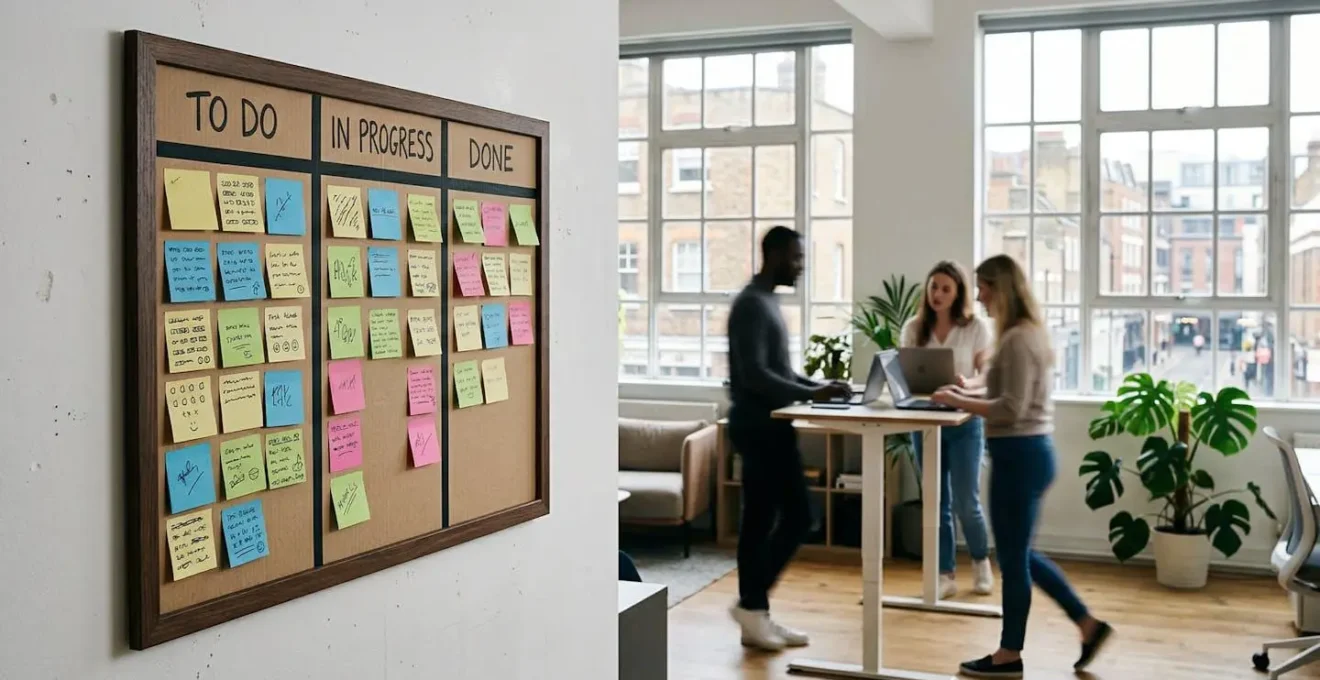
The key to aligning distributed teams isn’t more meetings or messages; it’s transforming your agile board into a single, shared reality that functions as the team’s central nervous system.
- Static tools like Gantt charts fail because they can’t adapt to the fluid nature of modern sprints, creating information silos.
- True alignment comes from disciplined board grooming and clear ticket statuses, which prevent cognitive overload and duplicated effort.
Recommendation: Shift your focus from simply tracking tasks to methodically engineering a frictionless workflow on your board that makes asynchronous collaboration intuitive.
For any scrum master coordinating a major software release across different time zones, the core challenge is not just managing tasks, but orchestrating alignment. How do you ensure a developer in Manchester, another in Edinburgh, and a third working flexible hours from Bristol are all pulling in the same direction without resorting to constant check-ins and progress meetings? Many teams turn to the usual advice: more frequent stand-ups, better communication tools, or stricter deadlines. While well-intentioned, these solutions often treat the symptoms, not the underlying disease of information fragmentation.
The common tools of project management, like Jira or Trello, are often used as simple digital bulletin boards—a place to park tasks. But what if the true power of an agile board isn’t just to show *what* needs to be done, but to create a living, breathing ‘shared reality’ for the entire team? The perspective we will explore here is that a masterfully curated agile board acts as the central nervous system for a distributed team. It’s a system designed to synchronize effort, surface blockers, and foster a state of asynchronous alignment, making much of the typical micromanagement redundant.
This guide offers a methodical approach for scrum masters to move beyond basic task tracking. We will deconstruct the common failure points of traditional methods, establish a rock-solid foundation for your sprint backlog, and explore the disciplined routines that prevent chaos. We’ll also examine how these principles, born in software development, can be adapted to other fast-paced UK industries like PR and marketing, and how to protect your team’s focus in a world of digital noise.
To navigate this methodical approach, the following sections will break down each critical component of engineering a high-performance agile board for your distributed team.
Summary: Engineering Alignment with Agile Project Boards
- Why Traditional Gantt Charts Fail Miserably for Fast-Paced Software Sprints ?
- How to Structure a Sprint Backlog That Junior Developers Actually Understand ?
- The Board Grooming Routine to Prevent Massive Ticket Accumulation
- The Ticket Status Mistake That Causes Dev Teams to Duplicate Work
- When to Move a Blocked Task From the Current Sprint Back to the Main Backlog ?
- How to Implement Two-Week Sprints in a Traditional PR Agency ?
- Why Having Slack, Teams, and Email Simultaneously Destroys Deep Work ?
- How to Engineer Faster Execution in Your Marketing Department Without Burnout ?
Why Traditional Gantt Charts Fail Miserably for Fast-Paced Software Sprints ?
The core failure of traditional project management tools like Gantt charts in a fast-paced sprint environment is their inherent rigidity. They are designed for a world of predictable, sequential tasks, where a master plan is created upfront and followed meticulously. However, software development, especially in an agile context, is a process of discovery. Priorities shift, technical challenges emerge unexpectedly, and user feedback can pivot the direction of an entire feature mid-sprint. The Gantt chart becomes an administrative burden rather than a useful guide. In fact, poor visibility into project status is a significant issue, with one report indicating that issues with project visibility contribute to the failure of nearly 47% of agile projects.
This static nature creates a dangerous disconnect between the plan and the reality of the development floor. Updating a complex Gantt chart to reflect a small change can be so cumbersome that it often doesn’t get done, leading to an outdated document that no one on the team trusts. This erodes the very foundation of a single source of truth, forcing team members to rely on ad-hoc conversations and memory to understand the real state of play—a recipe for disaster in a distributed team.
The problem is one of feedback-loop speed. An agile board provides real-time, visual feedback on progress, bottlenecks, and flow. A Gantt chart provides a historical snapshot that is often obsolete by the time it’s shared. As agile expert Simon Goodchild notes, this is a fundamental incompatibility:
Gantt charts are notoriously difficult and time-consuming to modify on short notice.
– Simon Goodchild, Why Gantt charts are not beneficial in an Agile organisation
Instead of a tool that locks the team into a predetermined path, distributed teams need a dynamic system that embraces change. The agile board is not just a replacement; it’s a philosophical shift from predictive planning to adaptive execution. It is the playing field, not just the scoreboard.
How to Structure a Sprint Backlog That Junior Developers Actually Understand ?
A clear sprint backlog is the bedrock of an effective agile board. If the items entering the « To Do » column are ambiguous, oversized, or lack context, the entire workflow is compromised from the start. This is especially true for junior developers, who may lack the experience to « read between the lines » or infer missing requirements. A backlog built for clarity minimizes questions, reduces rework, and empowers every team member to pick up a task and run with it confidently. The goal is to make each ticket a self-contained unit of work with a clear definition of « done. »
To achieve this, we must treat backlog items not as simple labels, but as well-defined packages of information. Every user story selected for the sprint should be broken down into smaller, concrete tasks. For a junior developer, a story like « Improve user profile page » is an un-actionable mountain. A task like « Add validation to the phone number field on the profile form » is a conquerable hill. This process of decomposition is crucial; it transforms abstract business value into tangible technical steps.
Furthermore, each task must include essential context. This means clearly stating the user story it belongs to, outlining acceptance criteria, and providing links to any necessary designs, documentation, or API endpoints. Think of each ticket as a « mission briefing » for the developer. By investing time in this upfront clarification, we dramatically reduce the cognitive load required to start work, which is a major source of friction and delay. The sprint backlog becomes less of a list and more of a bridge between the product’s grand vision and the team’s daily, focused execution.
The Board Grooming Routine to Prevent Massive Ticket Accumulation
An agile board, left untended, quickly devolves from a tool of clarity into a source of chaos. Tickets accumulate, statuses become stale, and the board no longer reflects reality. This is why a disciplined, recurring board grooming (or backlog refinement) routine is not an optional meeting but a critical system maintenance activity. It is the team’s collective opportunity to ensure the board remains a trusted, single source of truth. The scrum master’s role here is to facilitate this as a collaborative process, not a top-down directive.
This routine should be a fixed, time-boxed event in every sprint. Agile expert Mike Cohn famously suggests that teams should dedicate up to 10% of their sprint capacity to this activity. During this session, the team collectively reviews upcoming product backlog items, asks clarifying questions, adds estimates, and splits large stories into smaller, sprint-ready tasks. This isn’t about planning the next sprint; it’s about ensuring the raw materials for future sprints are clean, understood, and ready for consideration. It’s the proactive work that prevents reactive panic during sprint planning.

By treating board grooming as a non-negotiable team ritual, we prevent the « backlog graveyard » where ideas go to die. It keeps the system dynamics of the workflow healthy, ensuring a steady, predictable flow of well-prepared work into the development pipeline. For a distributed team, this shared ceremony is also a vital point of synchronous connection, reinforcing the sense of a unified mission and a shared understanding of the road ahead.
The Ticket Status Mistake That Causes Dev Teams to Duplicate Work
One of the most insidious and costly mistakes on an agile board is the ambiguous or misused ticket status. When a task is moved to « In Progress, » but is actually blocked waiting for a code review or an answer from another department, the board is lying. This hidden state forces other developers, looking for work, to either start a new task (increasing work-in-progress and context switching) or, worse, start working on a similar task, leading to duplicated effort. The board must reflect the true, granular state of work, not a simplified version.
The solution is to have explicit, agreed-upon statuses for common « waiting » states. For example, instead of a single « In Progress » column, a more mature board might have « In Development, » « Ready for Review, » « In Review, » and « Ready for QA. » This level of granularity makes bottlenecks instantly visible to the entire team. A pile-up of tickets in the « Ready for Review » column is a clear signal that senior developers need to prioritize reviewing code over starting new features. This visibility allows the team to self-organize and swarm on the bottleneck to restore a frictionless workflow.
To prevent the context-switching that leads to duplication, a powerful technique is to enforce strict Work-in-Progress (WIP) limits. As one expert guide on scrum board management advises, the root cause is often hidden blockers:
The core reason for duplication is context-switching born from hidden blockers.
– Agile Best Practices Expert, Scrum Board Management Guide
For instance, a WIP limit of ‘1’ for the « In Development » column per developer ensures that a developer must get their current task fully through the review and QA process before pulling new work. This forces them to actively unblock their existing tasks instead of starting new ones, which is the key to maintaining flow. This discipline, made visible on the board, is fundamental to achieving high-performance execution in a distributed setting. Some teams even use innovative tools like virtual reality scrum boards, as Motorola did, to improve engagement and achieve a 30% increase in sprint goal achievement by making these states more tangible.
When to Move a Blocked Task From the Current Sprint Back to the Main Backlog ?
A blocked task is a ticking time bomb in a sprint. It consumes cognitive space, jeopardizes the sprint goal, and can demoralize the team. The critical question for a scrum master is: when do we persevere, and when do we cut our losses and move it back to the product backlog? There isn’t a single magic number, but the decision should be guided by a clear, collaboratively agreed-upon framework based on time and impact.
A simple but effective rule is the « 48-hour » guideline. If a task is blocked and the team has not identified a clear path to unblocking it within two working days, it should be a candidate for removal from the sprint. This is not an admission of failure but an act of strategic realism. Keeping a hopelessly blocked task on the board creates noise and distracts from achievable goals. Moving it back to the product backlog allows the product owner to re-evaluate its priority and dependencies in a calmer context, and it frees the team to focus on delivering value elsewhere within the current sprint.
This decision must be a team conversation, typically during the daily stand-up. The key is to assess the blocker’s nature: Is it an internal dependency we can resolve, or an external one beyond our control (e.g., waiting on a third-party API fix)? If it’s the latter with an unknown resolution time, moving the task is almost always the right call. This discipline protects the sprint’s integrity and maintains the team’s velocity and morale. It reinforces the idea that the sprint commitment is a forecast, not a blood oath, and that adapting to reality is a core agile principle. This discipline is part of a larger commitment to respecting time and process.
Action Plan: Sprint Planning Time-Boxing Best Practices
- Constrain sprint planning to no more than two hours for each week of the sprint (e.g., a two-week sprint should have a maximum 4-hour planning meeting).
- Apply timeboxing: set a maximum amount of time for the team to accomplish the planning task.
- Have the scrum master ensure the meeting happens within the timebox and facilitates the discussion effectively.
- If the team is satisfied before the timebox expires, end the meeting early; there is no minimum time requirement.
- Confirm the team’s collective commitment to completing the selected work and clearly communicate the final sprint backlog to all stakeholders.
How to Implement Two-Week Sprints in a Traditional PR Agency ?
The principles of agile execution are not confined to software development. A traditional UK public relations agency, often dealing with unpredictable media cycles and tight client deadlines, can benefit immensely from the structure and focus of a two-week sprint. The challenge lies in translating agile concepts—like « user stories » and « velocity »—into a language that makes sense for PR professionals. Instead of « developing a feature, » a sprint goal might be « Secure three media placements for the Client X launch. »
The agile board becomes the agency’s mission control. The « To Do » column might contain tasks like « Draft press release, » « Build media list, » and « Pitch Journalist A at The Guardian. » The « In Progress » column shows what is actively being worked on, and « Done » provides a satisfying, tangible view of accomplishments. This visual workflow is incredibly powerful in a creative environment, replacing chaotic email chains and « who’s-doing-what » confusion with a clear, shared reality. With a significant portion of the UK workforce operating in new models—ONS data for early 2025 shows 28% are hybrid and 16% fully remote—this kind of asynchronous alignment tool is no longer a luxury but a necessity for collaborative industries like PR.

The key to a successful implementation is starting small. Begin with one client or one project team. Introduce the core ceremonies: a brief daily check-in (the stand-up), a sprint planning session to set the two-week goal, and a short retrospective to ask, « What went well? What could be better? » By focusing on the core principles of transparency, inspection, and adaptation, a PR agency can engineer a more predictable, less reactive, and ultimately more effective operational rhythm, even when dealing with the inherent chaos of the media landscape.
Why Having Slack, Teams, and Email Simultaneously Destroys Deep Work ?
In the modern distributed workplace, the promise of constant connectivity has backfired, creating a state of continuous partial attention. Having multiple communication channels running simultaneously—Slack for quick chats, Teams for video calls, and email for formal correspondence—fragments a developer’s focus and destroys their ability to perform deep work. Each notification is a potential context switch, pulling them out of the complex problem they are trying to solve. This « tool chaos » works directly against the focused environment that an agile board is meant to create.
The agile board should be the primary channel for communication *about the work*. A question about a specific ticket should be a comment on that ticket, not a direct message on Slack. This co-locates the conversation with its context, creating a permanent, searchable record for the whole team. It transforms communication from ephemeral chatter into a durable asset. When the board is established as the central nervous system for project communication, other tools can be relegated to their proper place: Slack for urgent, synchronous issues or social connection, and email for external or formal announcements.
This is not an anti-tool argument; it’s a pro-focus one. The goal is to create clear « rules of engagement » for communication. This failure to provide a streamlined toolchain is a widespread issue; research found that 63.91% of company leaders admit they lack the proper tools and practices to manage productivity effectively in a distributed environment. By channelling all work-related discussions through the agile board, we protect our team’s most valuable resource: their uninterrupted concentration. This allows them to enter a state of flow, which is where high-quality, creative problem-solving happens.
Key Takeaways
- An agile board’s primary function is not just task tracking but creating a ‘shared reality’ for a distributed team, making it the single source of truth for all work.
- Disciplined routines like board grooming and enforcing WIP limits are not bureaucratic overhead; they are essential maintenance activities that prevent chaos and ensure a smooth workflow.
- The principles of agile board management are highly transferable and can be used to engineer faster, more predictable execution in non-software fields like marketing and PR.
How to Engineer Faster Execution in Your Marketing Department Without Burnout ?
Marketing departments, much like PR agencies, often operate in a state of reactive urgency. Campaigns need to launch, content needs to be published, and analytics need to be reported—all at once. This constant pressure can easily lead to burnout. Engineering faster execution without sacrificing team well-being requires a shift from managing people’s time to managing the flow of work itself. This is precisely what an agile board system is designed to do.
By implementing two-week sprints, the marketing team can create a predictable rhythm. At the start of each sprint, the team commits to a realistic set of goals—for example, « Launch the Spring Sale campaign » and « Publish four blog posts. » These large goals are broken down into smaller tasks on the agile board: « Design ad creatives, » « Write email copy, » « Schedule social media posts, » etc. This provides clarity and transforms a mountain of work into a series of manageable steps. The visual nature of the board allows the team lead to see bottlenecks in real-time. If « Design ad creatives » is stuck, they can immediately investigate and provide support, rather than finding out a day before launch that nothing is ready.
Case Study: Agile Principles in Healthcare
The power of this visual workflow management extends far beyond creative or tech industries. At a major hospital, the implementation of a scrum agile board to manage patient care workflows led to a remarkable 40% reduction in average patient wait times. By visualizing the patient journey and identifying bottlenecks in real-time, the healthcare team was able to streamline their processes dramatically. This demonstrates that the core agile principles of visualizing work, limiting work-in-progress, and managing flow can drive significant efficiency gains in almost any complex system.
This approach fosters a culture of sustainable pace. Instead of an endless marathon, work is structured into a series of focused sprints with clear start and end points. The retrospective at the end of each sprint gives the team a formal opportunity to improve their process, addressing what caused stress or slowed them down. By focusing on improving the system, not just pushing people harder, a marketing department can achieve faster, more predictable execution while simultaneously reducing the risk of burnout.
To put these methodical principles into practice, the next logical step is to conduct a diagnostic of your own team’s agile board and routines to identify the most significant areas for improvement.