
True resource efficiency is not about isolated cost-cutting; it’s about building a real-time Data-to-Profit Pipeline from your factory floor to your financial software.
- Operational data (energy spikes, material waste) must be automatically translated into financial metrics (cost-per-unit, margin impact).
- Legacy machinery can become a source of rich intelligence using low-cost IIoT gateways, delaying expensive capital replacement.
Recommendation: Begin by mapping a single critical process to quantify its ‘data value’, proving the ROI of an integrated, system-wide approach before scaling.
As a plant manager in a UK energy-intensive factory, you are on the front line of a relentless battle against skyrocketing energy bills and tightening production margins. The pressure to cut operational expenditure is immense, yet the conventional advice often feels inadequate. You’re told to switch to LED lighting or launch another employee engagement campaign, but these are tactical skirmishes in a strategic war. They fail to address the systemic inefficiencies bleeding profit from your core processes.
But what if the real leverage isn’t in these fragmented actions, but in a fundamental shift in perspective? What if every watt of wasted energy and every gram of scrap material could be instantly translated into a real-time financial figure on your P&L statement? This is the principle of Operational-Financial Synthesis (OpFin): the deep integration of shop-floor data with high-level financial strategy. It’s about transforming operational metrics from retrospective reports into predictive, actionable financial intelligence.
This blueprint moves beyond the platitudes. It provides a structured, technical framework for UK manufacturers to build this Data-to-Profit Pipeline. We will dissect the critical connections between energy consumption, material waste, maintenance strategies, and ERP systems, providing a clear path to not just save money, but to create a more resilient, data-driven, and profitable operation.
This comprehensive guide details the technical and strategic steps required to achieve significant resource efficiency. Explore the sections below to build your factory’s blueprint for a more profitable and sustainable future.
Summary: A Blueprint for Total Resource Efficiency
- How to Cut Electricity Overhead by 15% Without Halting Assembly Lines?
- The Material Wastage Error That Erases Your Q2 Profit Margins
- Which Approach to Choose Between Preventative Maintenance and Reactive Repairs to Save Cash?
- Why Poor Shift Scheduling Leads to 20% Higher Overtime Costs?
- In What Order Should You Upgrade Legacy Machinery to Maximise Output?
- How to Automate Warehouse Quality Checks Without Sacrificing Accuracy?
- The Integration Strategy to Connect Legacy Assembly Machines to Modern Financial Software
- How Enterprise Resource Planning Eradicates Operational Silos in UK Manufacturing?
How to Cut Electricity Overhead by 15% Without Halting Assembly Lines?
Reducing electricity consumption in a 24/7 production environment is not about simply turning things off; it’s about strategic control and optimisation. While large-scale capital projects have their place, significant savings can be realised through targeted, low-disruption interventions. The focus must shift from blanket reduction to granular management, identifying parasitic loads and optimising consumption patterns in real-time. For instance, compressed air systems are notorious for their inefficiency, often accounting for a substantial portion of a factory’s electricity bill due to undetected leaks and suboptimal pressure settings.
A data-led approach is fundamental. This involves moving beyond monthly utility bills to sub-metering critical assets and production lines. This level of detail allows you to correlate energy usage with specific activities, shifts, and batches, revealing hidden costs. Furthermore, this data is the prerequisite for participating in advanced energy management programmes. UK-based manufacturers can leverage National Grid’s Demand Side Response (DSR) schemes, which offer a revenue generation opportunity by reducing load during peak demand periods. This transforms the energy department from a cost centre into a potential profit centre, directly linking operational flexibility to financial gain.
The key is to implement changes that enhance, rather than hinder, production. Optimising motor controls, fixing air leaks, or rescheduling non-essential high-load processes to off-peak tariff periods are all achievable without impacting assembly line uptime. It’s a surgical approach, using data to identify and eliminate the precise points of electrical waste. This methodology requires a shift in mindset from passive consumption to active energy management.
The Material Wastage Error That Erases Your Q2 Profit Margins
Material wastage is often accepted as an unavoidable ‘cost of doing business’, a line item in the budget that is monitored but rarely interrogated. This is a critical financial error. Every piece of scrap, off-cut, or rejected part is not just lost material; it’s a data point indicating a flaw in your process, a deviation in machine performance, or an issue with raw material quality. Framing waste solely as a disposal cost ignores its true value as a diagnostic tool. In the UK, where the manufacturing sector contributed to 10.6% of total waste, treating this issue strategically is paramount.
The concept of Waste Valorisation reframes the objective. It moves beyond simply reducing waste volume to systematically tracking its source, cause, and financial impact. This requires a visual and data-driven mapping of where waste is generated throughout the value stream, from raw material intake to final product shipment. By quantifying waste at each stage, you can pinpoint the most significant ‘profit leaks’ and prioritise your improvement efforts.

As this visualisation suggests, waste is not a single problem but a river with many tributaries. A spike in metal shavings at a CNC station might signal a need for tool recalibration, while an increase in rejected plastic mouldings could point to inconsistent material temperature. By connecting this operational data back to your financial systems, the cost of a ‘bad batch’ is no longer a vague estimate but a precise figure, including lost material, wasted energy, machine time, and labour. This direct financial link provides a powerful business case for investing in process control and quality improvements, turning a cost centre into a driver of enhanced profitability.
Which Approach to Choose Between Preventative Maintenance and Reactive Repairs to Save Cash?
The debate between preventative maintenance (PM) and reactive, ‘run-to-fail’ repairs is often oversimplified. A single, one-size-fits-all strategy is financially suboptimal. The most cost-effective approach is a hybrid model, dictated by data and a rigorous assessment of asset criticality. Applying an expensive PM schedule to a non-critical, redundant pump is as wasteful as allowing a production bottleneck machine to fail unexpectedly. The key is to allocate maintenance resources where they will protect the most value, not just where they are easiest to deploy.
A decision matrix that balances asset criticality against the cost-to-repair provides a logical framework for this strategy. Critical machinery with high repair costs justifies investment in predictive maintenance (PdM) using IIoT sensors to monitor health in real-time. Conversely, low-impact, inexpensive-to-fix assets may be best left to a run-to-fail model. This data-driven segmentation ensures that your maintenance budget is a strategic investment, not a blunt operational expense. The impact is direct and measurable; The Carbon Trust reports that poorly maintained motors can use up to 15% more energy than their maintained counterparts, creating a direct link between maintenance schedules and electricity bills.
This technical analysis allows for a more nuanced and financially optimised maintenance plan.
| Asset Criticality | Cost to Repair | Recommended Strategy | Expected Savings |
|---|---|---|---|
| Critical – High Impact | High (>£10,000) | Predictive with IIoT sensors | 15-20% reduction in downtime costs |
| Critical – High Impact | Low (<£1,000) | Preventative maintenance | 10-15% energy savings |
| Non-Critical | High (>£10,000) | Preventative with AIA consideration | Tax deduction benefits |
| Redundant/Low Impact | Low (<£1,000) | Run-to-fail (reactive) | Minimal maintenance overhead |
By adopting this matrix, maintenance shifts from being a reactive firefighting exercise to a proactive, risk-mitigation function. It allows you to focus your skilled technicians on high-value activities that prevent costly, production-halting failures, directly protecting your bottom line and optimising your operational expenditure (OpEx).
Why Poor Shift Scheduling Leads to 20% Higher Overtime Costs?
Inefficient shift scheduling is a silent drain on profitability, creating a cascade of hidden costs that extend far beyond payroll. The most obvious impact is a spike in overtime, often a reactive measure to cover production shortfalls caused by unplanned downtime or poor capacity planning. However, the financial damage runs deeper, particularly in the UK’s volatile energy market. Scheduling energy-intensive processes like heat treatment or large-scale mixing during peak hours can be financially devastating. According to the ONS, during peak demand periods, UK industrial electricity costs can reach £3,330/MWh, turning a standard production run into a high-cost event.
A Dynamic Scheduling approach integrates three critical data streams: production targets, maintenance schedules, and time-of-use electricity tariffs. This OpFin synthesis creates optimised schedules that minimise energy costs while maximising throughput. For example, a smart system can automatically schedule a high-load, non-urgent batch process to run overnight during the cheapest electricity period, freeing up peak-hour capacity for more critical, time-sensitive work. This not only cuts utility bills but also builds resilience into the production plan.

Furthermore, poor scheduling carries significant compliance risks. As one case study highlights, erratic or overly long shifts can breach UK Working Time Regulations, exposing the company to potential HSE (Health and Safety Executive) interventions and costly employment tribunal claims. By implementing an intelligent scheduling system, one UK manufacturer successfully aligned its operations with energy tariffs, reducing costs while simultaneously ensuring full regulatory compliance. This demonstrates that strategic scheduling is not merely an HR function but a critical lever for financial control and risk management.
In What Order Should You Upgrade Legacy Machinery to Maximise Output?
The directive to « upgrade legacy machinery » is often met with justifiable concern over capital expenditure (CapEx). A full-scale replacement strategy is not always feasible or financially prudent. The more strategic approach is to view your existing assets as a portfolio and prioritise upgrades based on a rigorous, data-driven analysis of their financial impact. The question is not « which machine is oldest? » but « which machine upgrade will deliver the fastest and largest return on investment? » This requires a shift towards Legacy Asset Intelligence.
The prioritisation process should be based on three core factors. First, measure the Energy Consumption per Unit (ECPU) for each key machine to identify the most significant energy hogs. Second, calculate the total Maintenance and Downtime Cost, including not just direct repair expenses but also the value of lost production. Third, apply the Theory of Constraints to identify the single machine that acts as the primary bottleneck for your entire production line. The machine that scores poorly across these three metrics—high ECPU, high downtime cost, and being a bottleneck—is your number one candidate for an upgrade or retrofit.
Often, a targeted retrofit can yield a significant portion of the benefits of a full replacement at a fraction of the cost. For example, in the UK manufacturing sector, retrofitting older motors with Variable Frequency Drives (VFDs) is a common high-impact upgrade. Innovate UK reports that Variable Frequency Drive retrofits typically achieve payback within 12 months through energy savings alone. This kind of targeted investment, guided by a clear ROI calculation, allows you to systematically improve output and efficiency without draining capital resources, transforming your CapEx budget into a high-performance investment tool.
How to Automate Warehouse Quality Checks Without Sacrificing Accuracy?
The pressure to increase throughput in warehousing and logistics often creates a conflict with the need for rigorous quality control. Manual inspection is slow, prone to human error, and becomes a significant bottleneck as order volumes rise. While full robotic automation seems like the ultimate solution, its high initial investment can be prohibitive for many UK SMEs. The optimal strategy often lies in a ‘human-in-the-loop’ approach, using technology to augment, not replace, human expertise.
A growing number of UK SMEs are demonstrating the power of this model by retrofitting existing conveyor systems with relatively low-cost, AI-powered vision systems. As one notable case study shows, these systems can increase quality check capacity by a factor of 10x while simultaneously improving accuracy compared to a fully manual process. The AI’s role is not to make the final decision on every item, but to perform high-speed screening. It automatically passes clear ‘good’ items and flags only the borderline or defective cases for review by a human supervisor. This frees up skilled personnel from repetitive tasks and allows them to focus their attention where it adds the most value: on complex or ambiguous defects.
The financial case for this hybrid approach is compelling, offering a balanced trade-off between investment, performance, and operational flexibility.
| System Type | Initial Investment | Throughput Capacity | Accuracy Rate | Human Resources Needed |
|---|---|---|---|---|
| Manual QC | £5,000-10,000 | 100 units/hour | 95-97% | 3-4 operators |
| AI Vision Retrofit | £25,000-50,000 | 1,000 units/hour | 98-99% | 1 supervisor |
| Full Robotic System | £200,000+ | 2,000 units/hour | 99.5% | 1 technician |
This table clearly illustrates that an AI retrofit provides a disproportionate increase in throughput and accuracy for a moderate investment. It represents the sweet spot for many operations, enabling a step-change in efficiency without the financial and operational disruption of a complete overhaul. It is a prime example of using technology to create scalable accuracy.
Key Takeaways
- Integrate operational data (OEE, waste) into financial systems (ERP) for real-time cost visibility.
- Prioritise low-cost retrofits (IIoT, VFDs) on legacy machinery before considering full replacement to maximise ROI.
- Align shift schedules with dynamic UK energy tariffs and maintenance needs to cut both utility and overtime costs.
The Integration Strategy to Connect Legacy Assembly Machines to Modern Financial Software
The greatest barrier to achieving true Operational-Financial Synthesis is often the ‘data gap’ between decades-old, reliable machinery and modern ERP or financial software. Your 30-year-old PLC-controlled press may be a workhorse, but it doesn’t speak the language of APIs and cloud analytics. Bridging this gap does not require replacing the entire machine. The solution lies in a phased integration strategy using Industrial Internet of Things (IIoT) gateways as translators.
These low-cost devices act as a bridge, capturing simple electronic signals from legacy equipment (e.g., uptime/downtime from a relay, cycle completion from a sensor) and converting them into a format that modern software can consume. This process unlocks a wealth of operational intelligence that was previously invisible. An investment in a sub-£200 gateway can begin the process of calculating real-time Overall Equipment Effectiveness (OEE), providing immediate, actionable data on your asset performance. This is the first step in building a compelling business case for further integration.
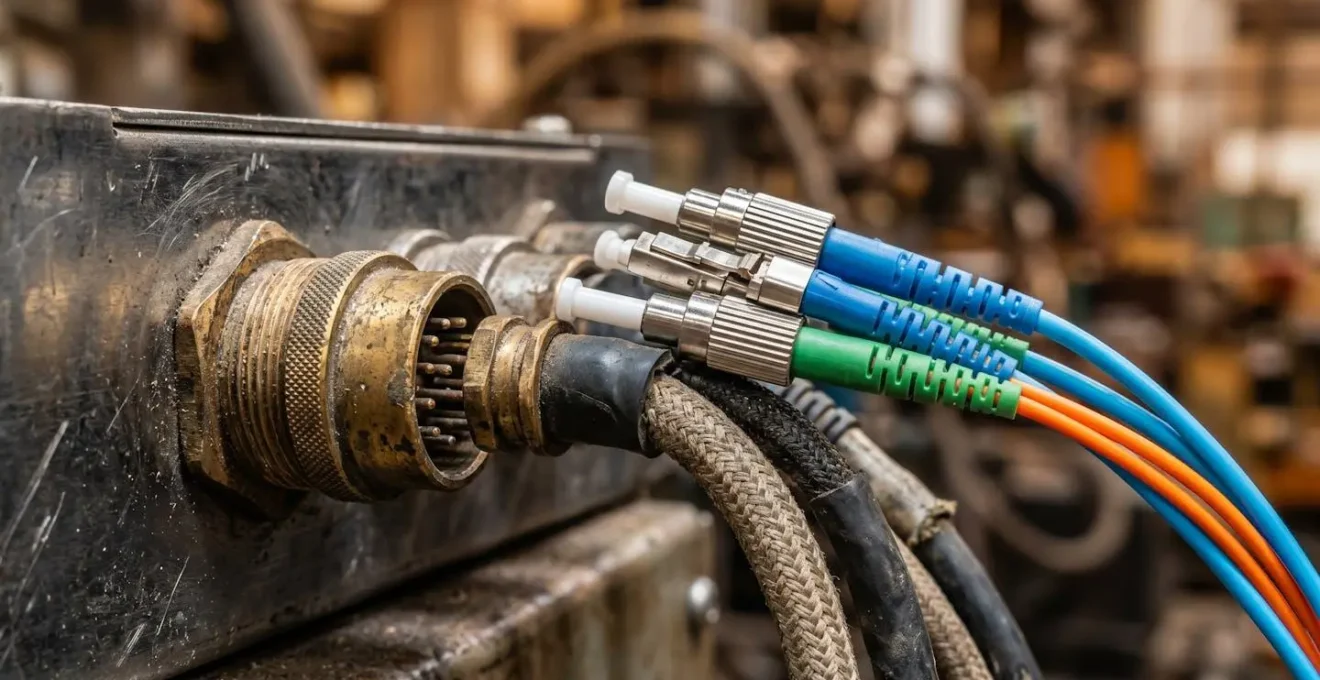
Once initial ROI is proven through improved OEE, the integration can be expanded to capture more granular data like energy consumption per cycle, tool wear metrics, and temperature fluctuations. This rich data stream can then be fed directly into your financial forecasting systems, enabling highly accurate, real-time cost-per-part calculations. This closes the loop, transforming a ‘dumb’ piece of legacy iron into a smart, data-producing asset that informs strategic financial decisions. The process should be methodical and results-driven.
Your Action Plan: Phased Legacy Machine Integration Roadmap
- Identify Pilot System: Select one critical legacy machine that is a known bottleneck or high-cost centre.
- Deploy Gateway for Basic Metrics: Install a low-cost IIoT gateway to capture fundamental uptime/downtime signals from its existing PLCs or sensors.
- Demonstrate ROI: Use the new data to calculate accurate OEE, prove the financial value of downtime reduction, and secure management buy-in for expansion.
- Expand Data Capture: Broaden the scope to include energy usage, cycle times, and other performance metrics for a richer dataset.
- Integrate with Financials: Feed real-time cost-per-part calculations directly into your ERP or financial forecasting software to enable dynamic pricing and margin analysis.
How Enterprise Resource Planning Eradicates Operational Silos in UK Manufacturing?
In many manufacturing businesses, departments operate in functional silos: production focuses on units per hour, procurement on material cost, and finance on retrospective monthly reports. An Enterprise Resource Planning (ERP) system, when implemented as the central nervous system of the operation, shatters these silos. It creates a single source of truth where an action in one department triggers an immediate and visible reaction in another, fostering a holistic, cause-and-effect understanding of the business.
Consider a practical example of this OpFin synthesis in the context of UK compliance. A modern, cloud-based ERP can be configured to manage the UK’s Plastic Packaging Tax. When a sensor on the factory floor (connected via an IIoT gateway) reports a spike in polymer scrap material, the Manufacturing Execution System (MES) data automatically triggers a series of events within the integrated ERP. An alert is sent to the quality department to investigate the process deviation. Simultaneously, the procurement module is notified to adjust its raw material forecasts. Most importantly, the financial module instantly updates its projected tax liability and calculates the cost of the wasted material against the production run’s margin. All of this occurs in real-time, without a single email or meeting.
This level of integration transforms an ERP from a passive accounting tool into an active, strategic management platform. It eliminates the latency between an operational event and its financial consequence. Decisions are no longer based on month-old data but on the immediate reality of the factory floor. By providing shared, real-time data across all functions, the ERP forces a unified perspective, ensuring that production, quality, and finance are all working towards the same goal: maximising profitable throughput.
To transform these principles into a concrete action plan, the next logical step is to conduct a diagnostic audit of your most energy-intensive process to establish a baseline and identify the highest-impact opportunities.
Frequently Asked Questions on The Blueprint for Efficient Resource Management in Energy-Intensive UK Factories
How does ERP handle UK-specific compliance requirements?
Modern cloud ERPs automatically track recycled content percentages for Plastic Packaging Tax and generate SECR-compliant energy reports.
What’s the typical ROI timeline for manufacturing ERP?
UK manufacturers typically see positive ROI within 12-18 months through reduced waste, improved OEE, and automated compliance reporting.
Can ERP integrate with existing legacy systems?
Yes, through middleware and IIoT gateways that translate legacy PLC signals into modern API formats the ERP can understand.